
初恋这件小事
Exclusive: ‘Like ripples on the sea’: Chinese astronomer tells Global Times how the Milky Way got its newly discovered ‘wrinkles’_我的网站

一 |
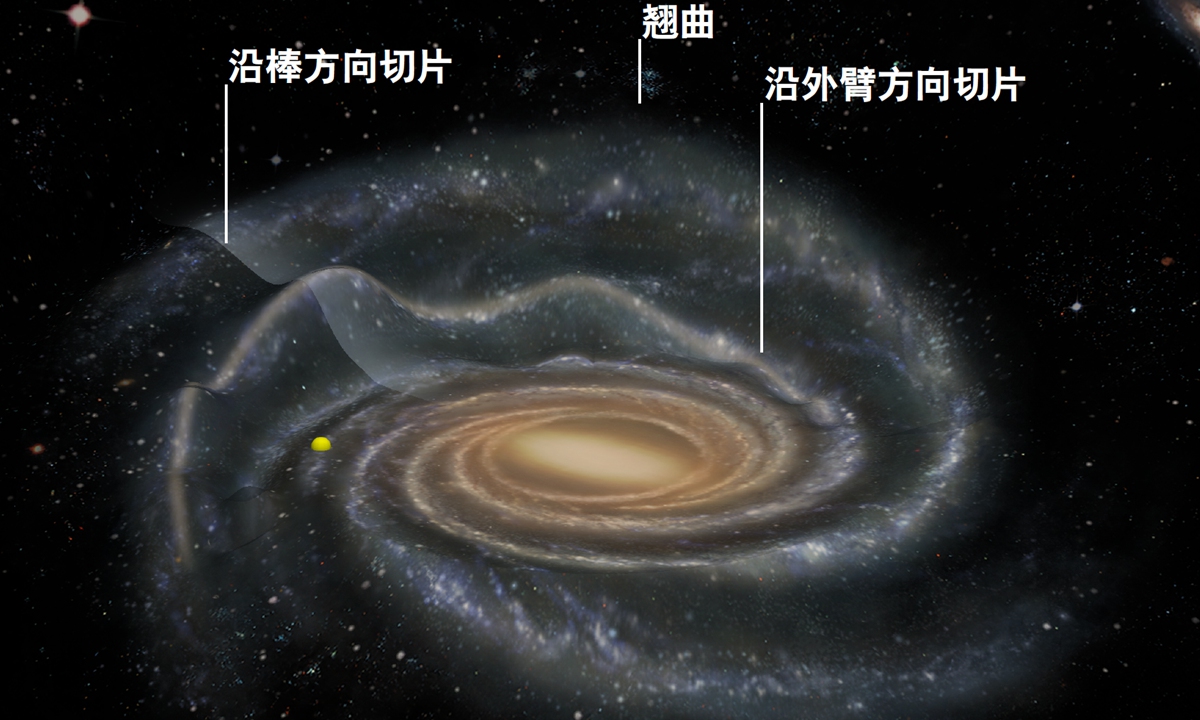
Chinese astronomers have discovered that the Milky Way is not a simple, smoothly warped disk, but contains widespread "wrinkle-like" structures resembling ripples on a water surface, providing new clues to understanding the galaxy's 3D structure and evolutionary history.
The discovery was made by a research team from the Purple Mountain Observatory (PMO) under the Chinese Academy of Sciences, using data from the "Milky Way Imaging Scroll Painting" (MWISP) survey. The findings were published online titled "Widespread corrugations superimposed on the Galactic warp in the outer CO disk" in the journal Nature Astronomy on August 7.
For decades, astronomers have known that the Milky Way's disk is not perfectly flat. Instead, its outer regions are slightly bent upward on one side and downward on the other - a structure known as a galactic warp.
However, the latest study shows that this large-scale bending is not the whole story. Smaller-scale vertical fluctuations are also embedded within the warped disk, creating a more complicated 3D structure.
"In many illustrations and in the public imagination, the Milky Way looks like a flat vinyl record," Sun Yan, associate researcher at PMO and the first author of the paper, told the Global Times on Tuesday. "In reality, the outer part of the Milky Way is more like a record that has been heated and deformed, with one side lifted and the other side lowered. That is the warp. On top of this large-scale deformation, there are additional smaller waves, which we call corrugations," Sun explained.
Using a more everyday analogy, Sun compared the Milky Way's structure to a sea surface. The warp is like a large swell that changes the overall height of the ocean, while corrugations are smaller waves superimposed on that swell.
"The two structures exist together. In our data analysis, we first removed the large-scale warp model, which allowed us to reveal the smaller wave-like patterns hidden underneath," Sun said.
The research focused on the Milky Way's outer gas disk rather than the more familiar stellar disk. According to Sun, cold molecular gas and stars provide two complementary ways to study the galaxy.
"Molecular gas is a sensitive probe for studying the vertical structure and dynamics of the galactic disk because it is concentrated near the disk plane and responds strongly to disturbances," she said.
Molecular gas is also the raw material for star formation, meaning its distribution is closely connected with the formation of young stars. The researchers traced this gas through carbon monoxide (CO) emission, which can penetrate regions obscured by interstellar dust and provide a different perspective from optical observations of stars.
The breakthrough was made possible by the MWISP survey, conducted using China's 13.7-meter millimeter-wave telescope.
"MWISP can be understood as giving the Milky Way a large-scale medical examination using millimeter-wave observations," Sun said.
Previous CO surveys were limited in sensitivity and coverage, making it difficult to accurately study the distant outer regions of the galaxy. In contrast, the latest study identified more than 30,000 molecular cloud samples, covering about half of the Milky Way's outer disk and extending to a distance of about 26 kiloparsecs from the Galactic center.
With such a large dataset, researchers were able to first establish a model of the overall warp and then separate subtle structures from the background. The newly identified corrugations have radial wavelengths of about 3.9-7.9 kiloparsecs and vertical amplitudes of about 100-200 parsecs.
The study also identified a corrugation structure extending about 40 kiloparsecs in azimuth at a distance of around 12.7 kiloparsecs from the Galactic center. In some spiral arm regions, vertical displacements can reach approximately 200 parsecs.
The researchers believe these large-scale vertical fluctuations are likely related to "bending waves" triggered by external gravitational disturbances, suggesting that the Milky Way might have experienced more complex interactions during its evolutionary history.
Although the newly discovered structures sound dramatic, they do not have any direct impact on Earth or the solar system. "Humans cannot directly sense these corrugations," Sun said. "Their scales reach thousands or even tens of thousands of light-years, and even if these structures are evolving, such changes would not be directly perceptible on human timescales."
The study focuses on the outer disk of the Milky Way and does not include the region around the solar system. "There is currently no evidence that these structures have any observable influence on Earth's environment," Sun said.
Instead, their significance lies in what they reveal about the past. Like geological layers recording Earth's history, these galactic structures preserve traces of the Milky Way's evolutionary journey, the researchers explained.
Researchers said future studies combining more precise motion measurements and numerical simulations could further reveal the origins of these structures and their role in the long-term evolution of the Milky Way.
。

二 | Kabul, Oct 15 (UNI) A year after banning most teenage girls from attending school, the Taliban are imposing sweeping restrictions on which courses women can enroll for in at public universities, a BBC report said.
The choice for female students can vary from university to university, and depending on which part of the country you're in, the BBC found. Women are allowed to take medicine and nursing in all provinces, as well as teacher training and Islamic studies.
But veterinary science, engineering, economics and agriculture appear off-limits to women nationwide, while opportunities to study journalism are extremely limited.
The militant group have said the correct "Islamic environment" needs to be created for older girls to be allowed back into schools. However, more than a year after they returned to power this still has not happened in most provinces, with reports suggesting hardliners in the group remain opposed to it.
Many girls did not get to complete their final year at school as girls were banned from high school by the Taliban after they seized power in August 2021, the BBC said.
The Taliban did, however, make the decision that girls who were in the last year of school could also sit university entrance exams.
This hope though appears short-lived with the limitations on the subjects being introduced for women only.
At several universities, the BBC report said, female students were given the option of taking a test in subjects such as nursing, midwifery or literature, which are among the courses on offer at the seven faculties open to them at Nangarhar, but not in journalism.
University professors who supervised the entrance examination there confirmed to the BBC that boys would be allowed to choose any subject they want.
Officials expect 100,000 students (including 30,000 women) were likely to take university entrance exams in Afghanistan this year, the BBC said.
The academic year starts either in March or August, and it usually takes two to three months for entrance exam results to be announced. Now, with the Taliban back in power, nobody is sure when the results will be released, the BBC reported.
Male and female students have been taking the exams separately - in line with Taliban rules on segregating students by gender - for example boys in the morning, girls in the afternoon or by using screens in exam halls. In some provinces where the candidate numbers were high, entrance exams were held over two or three days.
Activists told the BBC, the number of female students applying for university will fall dramatically in the coming years, unless the Taliban reopen secondary schools to girls from grades 6 to 12.
Taliban officials are downplaying the restrictions. Abdul Qadir Khamush, who heads the examinations division in the Ministry of Higher Education, says girls can choose their favourite subject, with the exception of just three or four.
"We need to provide separate classes for women. In some areas the number of female candidates are low. So we are not allowing women to apply for certain courses."
Officials are yet to reveal the number of university places on offer this year.
Afghanistan's education sector was badly affected after the Taliban takeover and there has been an exodus of trained academics after the withdrawal of US-led forces last year.
The country's economy has been largely dependent on foreign aid in recent decades, but aid agencies have partly - and in some cases fully - withdrawn support to the education sector after the Taliban refused to allow girls into all secondary schools.
Many of the teaching staff who remain go unpaid for months, the BBC reported.
Taliban restrictions on which subjects girls can study are not always uniformly applied across the country, the BBC discovered. For instance, in Kabul University, girls are still allowed on some courses in the journalism faculty.
But girls cannot circumvent the distance-rule. The Taliban have divided the country into a number of zones and girls are not allowed to study outside them, in what amounts to another very serious restriction based on sex, the BBC found.
UNI ING。

三 |
Current article:http://4wga1.tichuaiyuxiongbenmiemang.shop/9wav0/rhf.html
Published on:00:00:00


1
6天内的第4个台风来了……刚刚,今年第21号台风 “艾莎尼”生成!超强台风“沙德尔”进入东海后的路径和强度,它是重要影响因素2
多部门开展燃气安全联合检查3
微信方言采集被吐槽!官方称算法有时候很蠢 已剔除不靠谱内容4
@福建人 “台风+暴雨”安全指南请查收!5
挪威计划加强智能眼镜监管,考虑禁止在公共场所使用人脸识别功能6
US Homeland Security Agents Indicted With ‘Chinese Spying’ Charges7
这场亲子水上嘉年华“划”出了同心圆8
预售16.98万元起 2026款零跑C16将于6月中下旬正式上市9
China achieves mass production of advanced specialty steel across multiple sectors10
A British man pleads guilty to Islamic State-related terrorism charges11
智元子公司灵巧手OmniHand获机器人运动会7枚金牌12
毕丹星要求和易华仁案一样于高庭受审 高庭法官下个月裁决13
新西兰将哈马斯的政治机构指定为恐怖主义实体14
“天下没有不散的筵席”:《Doctor Who》编剧认为剧集回归“可能悄然告吹”15
Jewish schools, community groups warn parents to monitor kids' social media amid conflict in Israel
- 随机推荐
1
기모바지 샀는데 여름바지 배송···“유튜브 광고 해외쇼핑몰 주의하세요”2
从央行会议中,看四个关键政策动向3
爱依瑞斯BAOBAO亮相三里屯 以城市新场景拓展品牌年轻表达4
エレベーター閉じ込め、20人全員を救助5
고 노무현 대통령 탄생 80주년, 29일 봉하마을서 행사6
济南:“普惠+特殊”服务 为先模人物赠送大病互助保障7
北京:确诊病例曾乘北京地铁14号线,相关站点核酸检测均阴性8
韩国警方及公调处派千余人逮捕尹锡悦,现场发生肢体冲突9
漫步者 Comfo Clip Q2 智能耳夹耳机发布:海思谛听芯片 + 开源鸿蒙,399 元10
飞牛四盘位万兆 NAS EVO4 PRO 开售:锐龙 7 H 255,售价 4599 元起11
金风科技:上半年净利润18.55亿元,同比增长24.67%12
京东健康减重投诉13
中际旭创A股成交额达200亿元14
是尽快放手还是推进和谈:美国在乌克兰究竟想得到什么?15
难逃电气化,兰博基尼Aventador继任车型将搭载V12插混系统